
Every weekday morning at a Life Skills Development program in Florida, five intellectually disabled men were handed pedometers and reminded of a simple rule: the more they walked, the more money they would earn. Twenty-five cents for every thousand steps. Walk enough laps around the fenced yard and the quarters slowly accumulated on a board where everyone could see them. It looked, from a distance, like an incentive program. Up close, it looked like something else.
This was not a job posting. It was not vocational training, recreation, or a wellness class. It was research—an experiment designed to find out how reliably adult bodies could be made to perform when movement was converted into cash. In 2018, Diego Valbuena submitted his doctoral dissertation to the University of South Florida’s Ph.D. program in Applied Behavior Analysis. The study was titled, “Monetary Reinforcement for Increasing Walking in Adults with Intellectual Disabilities“. The project was framed as a modest health intervention, a practical way to address sedentary behavior among people labeled vulnerable. The language is calm, clinical, and reasonable. The arrangement underneath it is less so.
The study does not ask whether walking matters to the men who were asked to do it, or whether their program offered any meaningful reason to move in the first place. It asks a narrower question: if you attach money to steps, will the steps appear? That question has an obvious answer. The harder question—whether payment in a controlled setting becomes a form of leverage over people with little economic power—never quite reaches the page.
The frame that makes coercion disappear
The dissertation opens with a sentence that could have been copied from any public-health brochure: physical inactivity is a widespread problem associated with numerous health risks. It is a statement so ordinary it barely registers as an argument. But it does important work. From that line forward, walking is positioned as medicine and sitting as disease. The men in the study are not described as people living inside a tightly managed program; they are described as carriers of a behavioral deficit. Once the problem is defined this way, almost anything done in the name of increasing steps begins to look reasonable.
What never appears is the environment that produced the so-called inactivity. These adults spent their days in a segregated setting with staff-controlled schedules, limited transportation, and few choices about where to go or what to do. Walking was not forbidden, but neither was it woven into ordinary life with destinations, errands, or social reasons to move. The dissertation treats this background as neutral scenery rather than as the central fact. If people are still in a place designed for sitting, the solution becomes to fix the people, not the place.
The language follows a familiar behavioral script. Inactivity is an attribute of the individual, like a slow pulse or high cholesterol. The program itself disappears behind the curtain of clinical description. By the time the methods section arrives, the ethical question has already been trimmed down to a technical one: what arrangement of prompts, devices, and payments will make these bodies produce more steps? Whether the arrangement resembles work more than care is treated as beside the point.
This is how coercion fades from view. If movement equals health, and health equals treatment, then paying adults to walk becomes a therapeutic tool rather than an economic pressure. The fact that the same arrangement would be called piece-rate labor in any other context simply does not enter the frame. The dissertation never argues that payment is not coercive; it organizes the problem so the issue never needs to be raised.
By the time the reader reaches the first graph, the ground has been prepared. The men are inactive, inactivity is dangerous, walking is medicine, and medicine is the researcher’s business. What remains is a matter of efficiency—how to deliver the dose. The question of whether the dose is being administered under conditions that resemble choice or compulsion has already slipped out the back door.

Listed, screened, not known
The participants enter the dissertation through a set of gates. They had to be between eighteen and sixty-five, labeled with mild to moderate intellectual disability, ambulatory, their own guardians, and able to pass a medical checklist called the Physical Activity Readiness Questionnaire (PAR). The program’s clinical director supplied a pool of candidates she considered the “least active.” From that pool the researcher chose his subjects. On paper these steps read like routine safeguards. In practice they perform a quieter function: they convert ordinary adults into appropriate raw material for an experiment.
The criteria appear neutral because they borrow the tone of medicine. IQ ranges, mobility status, and PAR-Q responses are presented as objective facts, as if they were no more controversial than blood pressure. Yet each item carries a story about who is allowed to be studied and on what terms. Passing the questionnaire does not simply protect participants from physical harm; it clears them for use. Once screened and sorted, they arrive in the text as data points rather than neighbors.
One man, called Drew, receives a fuller description. The list is long: intellectual disability, schizoaffective disorder, intermittent explosive disorder with self-injury and pica, scoliosis, congenital deformities of both feet, reflux. The catalogue is clinical and exhaustive. Before we learn anything about his preferences, habits, or temperament, we learn how many ways his body has been classified. He appears on the page already medicalized, already defined as a management challenge awaiting technique.
What never arrives is the ordinary human information that would make these men recognizable. We are not told whether any of them liked to walk before the study began, whether they hated wearing devices on their wrists, whether they felt embarrassed being watched, or whether they understood that their steps were part of an experiment. Consent is procedural, not personal. Motivation is assumed rather than explored.
They are listed in tables and appendices. They are screened by forms and scores. But they are not known. The dissertation treats that absence as irrelevant, as if the meaning of walking could be separated from the people doing it.
Piece-rate walking
The first phase of the study was arranged with the simplicity of a factory shift. Each man was given an hour of what the dissertation calls “unstructured” time. During baseline sessions the pedometer screens were taped shut and no money was available. During intervention sessions the tape came off and a rule was announced: twenty-five cents for every thousand steps. A small board with quarters and dollar bills hung nearby, a visible scoreboard translating bodies into currency.
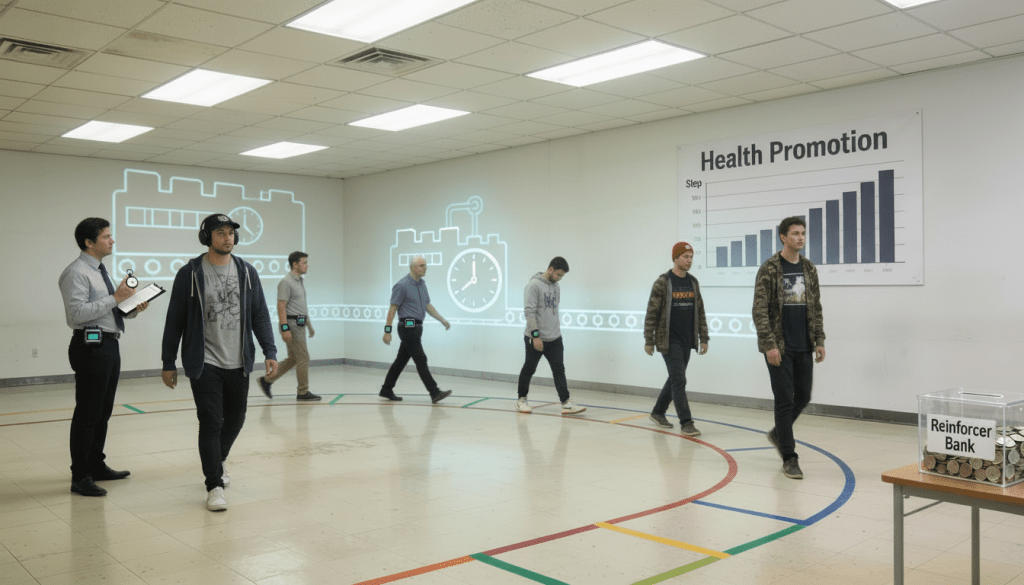
The pattern that followed was entirely predictable. When money appeared, walking increased. When money disappeared, walking declined. When money returned, the steps returned with it. The dissertation describes this as experimental control, proof that the independent variable was doing its job. In any other setting the arrangement would have a simpler name: piece-rate pay for bodily output inside a controlled workspace.
Nothing else about the hour changed. The men were not offered places to go, people to meet, or tasks that required movement. There were no errands, no destinations, no social reasons to leave a chair. The only difference between baseline and intervention was the presence of coins. Walking was stripped of context and given a wage. Movement itself became the job.
The logic is stark. If you want more steps, pay for more steps. The dissertation treats this as a therapeutic insight rather than as an economic one. Yet the mechanism is identical to the way day laborers are paid by the bucket or garment workers by the sleeve. Production rises because income depends on production. Calling the arrangement “reinforcement” does not change what it is.
There is also something revealing in the way the baseline is constructed. Taping the screens shut ensures that the men cannot even see their own activity unless money is on offer. Information becomes part of the pay structure. The study does not ask whether people might walk for curiosity, pleasure, or habit if given ordinary opportunities. It asks only how their behavior responds to a price.
From the graphs the conclusion looks tidy. From the floor of the program it looks like adults pacing in circles for quarters while staff count. The dissertation names this health promotion. It could just as easily be described as the lowest rung of wage labor, relocated inside a therapeutic vocabulary.
Extinction as loss
Behavior analysis has a clean word for the moment payment stops: extinction. In the textbooks it is a neutral phase, a necessary contrast to show that the contingency is working. On the page it looks as bloodless as turning off a light switch. In ordinary life the same event has a plainer name—having wages taken away.
The dissertation treats this removal as ethically weightless, a routine step in the design. Yet for adults who rarely handle money of their own, the disappearance of quarters is not an abstract variable. It is the vanishing of one of the few tangible resources the program allows them to touch. What appears from above as methodological elegance can feel from below like punishment for failing to produce.
Nothing in the study examines that experience. The men are not asked how it felt when the coins stopped appearing on the board, or whether they understood why yesterday’s effort no longer counted. The graphs simply register fewer steps, as if motivation were a faucet that can be opened and closed without consequence.
This is the quiet asymmetry of the arrangement. Researchers get clean data; participants get a lesson in economic dependence. The design assumes that taking money away carries no meaning beyond measurement. But in a setting where cash is scarce and choice is thin, extinction is not a neutral baseline. It is a reminder of who controls the pay window.
Surveillance of daily life
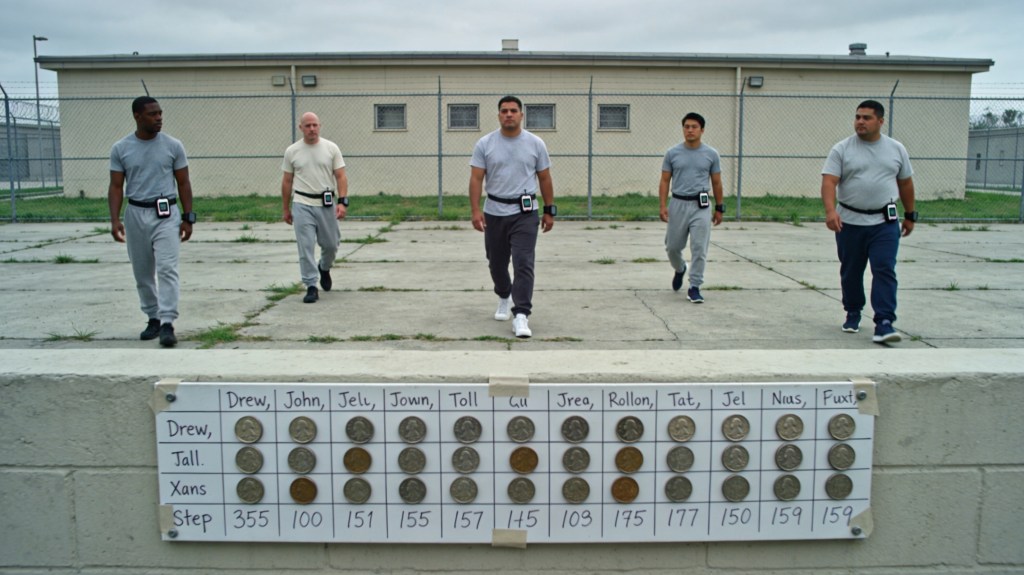
The second phase of the study abandoned the one-hour shift and spread the arrangement across the whole day. Six different men were asked to wear Fitbit devices from Monday through Friday. Every step, wherever it occurred, was counted. Payment was no longer immediate but totaled at week’s end, and a small bonus was offered simply for keeping the device on and syncing it correctly.
The effect was to convert ordinary life into a ledger. Walking to the restroom, to lunch, to the van, to a chair across the room—each movement acquired a price tag. The dissertation describes this as a naturalistic extension of the intervention. Another way to describe it is continuous surveillance tied to wages.
Predictably, the results grew messy. People were absent, devices were misplaced, schedules interfered. Some men walked more, some less, and the tidy experimental pattern of the first phase blurred. Rather than treating this as a sign that the arrangement might be ill-suited to real lives, the dissertation treats it as an implementation problem: better reminders, clearer rules, more consistent data collection.
What never appears is the simpler possibility that turning a person’s entire day into a reinforcement schedule might be ethically wrong. The study assumes that more coverage equals better science. If an hour of paid walking is good, a week must be better. The question of whether adults should live under a step-counting pay regime is not on the agenda.
The Fitbits also altered the relationship between staff and participants. Every motion became observable and monetized, and the men were expected to cooperate with charging, syncing, and troubleshooting the devices. Compliance was not limited to walking; it extended to managing the machinery that watched them. The bonus for wearing the tracker makes this explicit: part of the job was to submit to measurement.
There is something intimate about counting a person’s steps all day, something that would feel intrusive if applied to most adults. Inside the dissertation that intimacy dissolves into columns of numbers. The device becomes a neutral tool rather than a tether. Yet for the men wearing it, the line between living and producing data must have been hard to see.
When the outcomes disappointed, the study did not question the premise. It questioned the execution. The possibility that daily life should not be organized as a paid performance never interrupted the analysis. Surveillance was treated as a technical upgrade, not as a moral choice.
Social validity theatre
Near the end of the dissertation the men were given what behavior analysis calls a social validity survey. The questions were simple: Did you like earning money for walking? Would you keep walking more if the money stopped? The answers were equally simple. They liked the money. They would not keep walking without it.
Inside the study these answers are treated as evidence of success. If participants approve of the arrangement, the arrangement must be socially valid. The logic moves in a tight circle: payment produces walking, participants prefer payment, therefore payment is the right intervention.
What the survey never asks is whether the men felt pressured, bored, or confused; whether they disliked being watched; whether they thought walking for coins was a fair way to spend their day. Social validity measures acceptance of the contingency, not the justice of the contingency itself. Liking money is quietly translated into consenting to the experiment.
This is a familiar trick in applied behavior analysis. Approval is recorded only after people have adapted to the system offered to them. There is no space to say, “I would rather have something to walk to,” or “I don’t want my steps turned into wages,” or “I would prefer a real job.” Dissent has no box on the form.
The survey functions less as a safeguard than as a curtain call. Participants are invited to applaud the play they were required to perform. If they clap, the production is declared humane. If they do not, the solution is usually more reinforcement, not a different stage.

AI-generated image depicting five sporty young men wearing fitness trackers walking laps past an empty swing set, while a therapist with a clipboard directs them away from the swings.
Minimal risk, maximal pressure
An Institutional Review Board (IRB) is supposed to do one basic job: decide whether a study exposes human beings to harm that cannot be justified by the potential benefit. IRBs do not judge whether a project is interesting or effective; they are meant to ask whether the people inside it are protected. To make that decision, researchers describe what they plan to do, what could go wrong, and how those risks will be minimized.
In this case the study was presented to the IRB as ‘minimal risk.’ Walking is an ordinary activity. The payments were small. Participants completed a medical checklist to rule out heart or orthopedic problems. Framed this way, the project looked like a gentle wellness program with a bit of bookkeeping attached. On those terms, expedited approval was almost automatic.
But the description given to the IRB defined risk only as the chance of physical injury. The application asked whether someone might fall, strain a muscle, or overexert. It did not ask whether adults might feel coerced by money they rarely control, or whether being monitored all day could be humiliating, or whether paying people to move inside a locked schedule might resemble labor more than care. Those possibilities were outside the category the IRB was invited to consider.
This is not an accident. Ethical review depends entirely on how a study is framed. If the researcher calls the arrangement “exercise promotion,” the board evaluates it like exercise promotion. If he had called it “piece-rate payment for bodily output,” the conversation would have been different. The same set of actions can look harmless or troubling depending on which words appear on the form.
The consent process reflects the same narrowing. Participants were “recruited” from a group staff considered inactive, but the dissertation says little about how the men were approached, what alternatives they were offered, or whether declining could affect their standing in the program. An IRB is meant to protect voluntary choice; here voluntariness is assumed rather than demonstrated.
By limiting risk to bones and joints, the review clears the field of everything social. Economic pressure, loss of dignity, the experience of being watched, the message that one’s value lies in producing steps—none of these count as hazards because they cannot be measured with a stethoscope. Minimal risk on paper becomes maximal pressure on the ground.
The result is a familiar inversion. The men are treated as medically fragile enough to require screening, yet socially robust enough to have their days reorganized around a pay-for-performance scheme. Protection is offered to their ankles, not to their autonomy. The IRB does exactly what it was asked to do—and nothing it was not asked to imagine.
The questions that remain outside the data
The dissertation is crowded with numbers, yet the simplest questions never make it onto the page. A family member reading along might pause at points the researcher passes by:
- Why must an adult be paid to move inside a program that already organizes his entire day?
- Why is money called therapy here but wages everywhere else?
- What happens to the supposed health benefit the moment the quarters stop?
- Would any of this be acceptable if the subjects were not disabled?
These are not sentimental questions. They are questions about labor.
If a person is paid to perform a task set by others, on a schedule he does not control, under observation, in exchange for cash—is he not an employee? If the amount he receives depends on how much he produces, is that not a wage? The dissertation never pauses over these words, yet the arrangement fits them neatly. Walking becomes a unit of output, payment becomes compensation, and the program floor begins to resemble a very small factory.
Once the transaction is viewed this way, other implications follow. Employees have rights: to understand the terms of their work, to refuse unsafe or degrading conditions, to be paid fairly, to have a voice in how labor is organized. None of those protections appear in the study because the men are not called workers. They are called participants, and the coins are called reinforcement.
The language does heavy lifting. By naming the arrangement treatment, the dissertation sidesteps the obligations that attach to wages. Taxes, minimum pay, labor standards, even the basic question of whether someone can quit without penalty—all disappear behind a therapeutic curtain. The same structure that would raise alarms in an ordinary workplace becomes benign when performed in the name of health.
The study’s data cannot address these issues because the data were never designed to see them. Steps can be counted; dignity cannot. Graphs can show production; they cannot show whether a man felt proud, embarrassed, or quietly resentful pacing for quarters while others watched. The method answers the question it asked, but the question itself is too small.
What remains outside the data is the possibility that the experiment did not reveal a medical truth at all, but a familiar economic one: people will work when you pay them. The harder question—whether paying disabled adults to walk is work or care, wage or treatment—is left for someone else to ask.
Treatment or work?
The dissertation ends on a confident note. Monetary reinforcement, it says, is effective and feasible. The words sound technical, but the meaning is plain: the arrangement succeeded at making people walk while coins were on the table. Beyond that narrow effect the evidence thins quickly. No long-term health outcomes are demonstrated, no lasting habits formed, no increase in choice or independence, no hint of joy measured along the way.
Walking is not the intervention.
Money is.
Compliance is the outcome.
Calling this treatment launders a familiar economic relation through clinical language. Adults who already lived under institutional authority were turned into hourly workers paid to perform a bodily task chosen by professionals. The coins functioned exactly as wages function anywhere else: they purchased effort. The dissertation treats that fact as a therapeutic breakthrough rather than as a statement about power.
The study does prove something real. When you pay people for movement, they move. Factories learned that a century ago. But that truth belongs to labor economics, not to care. To confuse the two is to mistake a lever for a cure.
Nothing in the pages explains why walking should require payment at all, or why a program meant to support adult lives could not offer ordinary reasons to move—places to go, people to meet, tasks worth doing. Those possibilities are absent because they cannot be captured by a reinforcement schedule. Money is easier to count.
Until behavior analysis can tell the difference between helping a person live and buying a person’s steps, it will continue to mistake the rattle of quarters for evidence of health. The discipline will congratulate itself for producing graphs while ignoring the simpler question of whether the people inside those graphs were treated like patients or like very cheap labor.
Conclusion
The dissertation presents itself as a small contribution to health promotion, a clever way to help a few men take more steps. Read more carefully, it describes something narrower and less comfortable: a demonstration that people with limited power will work for coins when coins are made the condition of ordinary movement. That finding is neither surprising nor medical. It is a lesson the wider economy has rehearsed for generations.
Nothing in the study shows that the men became healthier, freer, or more connected to the world beyond the program fence. What increased was output under observation. When the payment stopped, the output faded. The arrangement functioned exactly as a wage system functions—effective while the wage is present, empty when it is not.
Behavior analysis likes to claim a special status as evidence-based care. Evidence matters, but so do categories. If we cannot distinguish between treatment and labor, between support and purchase, then the evidence will lead us in the wrong direction with great precision. The men in this study were not asked what kind of lives they wanted. They were asked how many steps they would sell.
A field that measures people by the footstep will eventually forget that people are more than feet. Until that changes, studies like this will continue to confuse the sound of quarters on a board with the sound of well-being—and call the mistake science.
Read the dissertation: Valbuena, D. (2018). Monetary Reinforcement for Increasing Walking in Adults with Intellectual Disabilities. University of South Florida.
 Misbehaviorist .com
Leave a comment