In 2020, Marlesha C. Bell submitted her doctoral research dissertation, titled Changing the Culture of Consent: Teaching Young Children Personal Boundaries in partial fulfillment of the requirements for the Doctor of Philosophy in Applied Behavior Analysis at the University of South Florida. The project appeared during the COVID-19 pandemic, a period of institutional pressure for Applied Behavior Analysis (ABA) to demonstrate ethical relevance, telehealth viability, and cultural responsiveness. It presents behavioral skills training and video modeling as proof that ABA can adapt and replicate under remote service delivery conditions.
The primary purpose of the study was to teach typically developing children consent skills through lessons framed around personal boundaries. The stated goal was to evaluate whether behavioral skills training and video modeling were effective in producing those skills. The consent taught in this study referred to everyday personal boundaries, such as asking permission before touching someone or entering their space, not sexual behavior. The broader goal was to build early autonomy and boundary-respecting skills that could later help prevent exploitation, but the lessons themselves were non-sexual and designed to be developmentally appropriate.
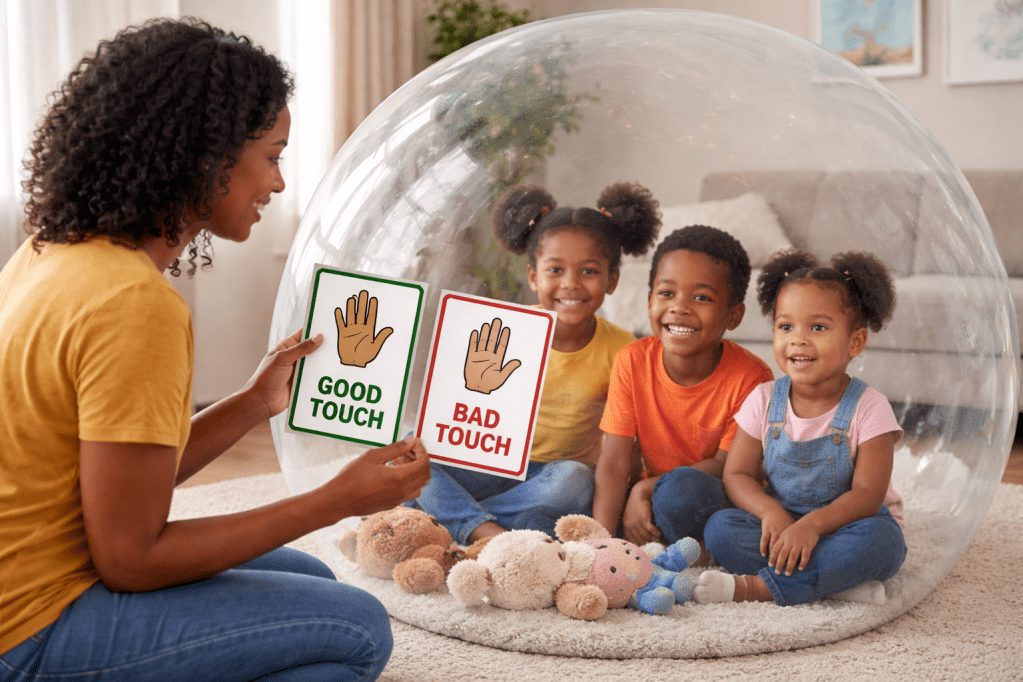
AI-generated image depicting three young Black children sitting inside a transparent protective bubble in a living room, while a parent stands outside the bubble holding two laminated cards labeled “Good Touch” and “Bad Touch.”
In the United States, parents have a constitutional right to direct the upbringing and education of their children. Teaching young children about bodily autonomy, boundaries, and consent has historically belonged to families, communities, faith traditions, and early childhood education. It does not require medicalization and is not a covered health benefit. When consent education is reframed as a behavioral intervention requiring doctoral-level expertise, something significant shifts. Ordinary parenting is recast as insufficient. Relational teaching becomes a technical problem. Authority moves away from families and toward a clinical discipline.
This is not a neutral shift. It is a jurisdictional one. By positioning consent as a behavioral deficit that must be remediated, the study implicitly casts Applied Behavior Analysis (ABA) as the necessary safeguard for vulnerable children. ABA becomes not one option among many, but the end-all solution for safety.
Teaching young children about consent does not require a doctorate. Claiming scientific authority over consent as a behavioral intervention does. This behaviorist framed consent as a new cultural practice. The study draws on Skinner to argue that cultural practices persist only when they are reinforced by a group. Teaching one child is described as insufficient. Group level instruction is presented as necessary to change culture. The study proposes that when most members of a group practice appropriate consent skills, those skills will contact reinforcement from peers and adults, leading to a change in the culture of consent.
Who Participated
Families were recruited through an email list from the preschool on the University of South Florida (USF) campus where Bell, the behaviorism researcher, was pursuing her doctoral degree. Seven children participated across three families. All children were described as typically developing. Ages ranged from two to ten years old. The Garner family included three children. The Brown family included two children. The Martin family included two children. The children named in the results section are Alexandra, age six. Delilah, age seven. Aiden, age six. Arianna, age six. Isaac, age ten.
All families were Black. The researcher explicitly notes that this matched her own race. She explains that this may have reduced mistrust and increased engagement. One family reported that their son preferred Black female educators. Video models were selected to match the race of the children.
Sessions were conducted in the children’s homes using telehealth platforms. Parents participated as interaction partners during role plays. Sessions were recorded. These details matter because translational value depends on who bears the burden of proof.
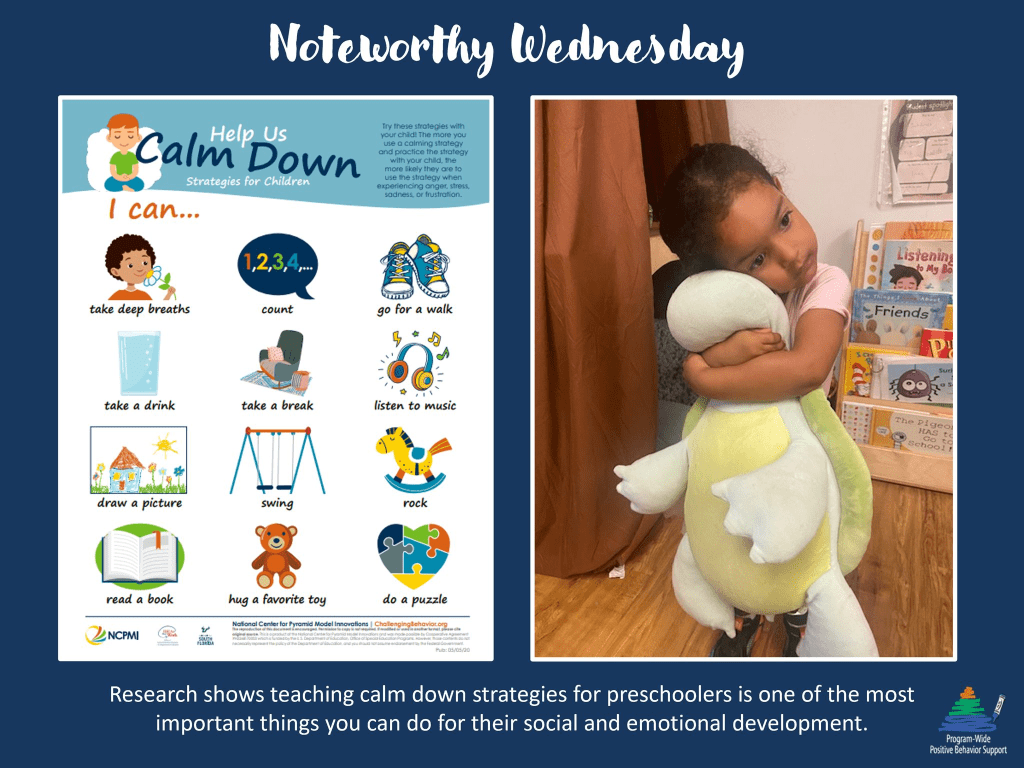
Publicly posted Facebook image from USF Preschool for Creative Learning highlighting calm-down strategies, featuring a young child hugging a stuffed toy to model emotional regulation skills.
What the Children Did
Before the intervention, children participated in structured role-plays with a parent to assess their existing consent skills. They had opportunities to (1) set and maintain or change their own boundaries (e.g., saying “no” to being touched) and (2) seek and respect others’ boundaries (e.g., asking permission before taking an item and accepting “no”). Points were scored for clear, overt responses such as verbally saying “no” or asking permission appropriately, while no feedback was given during baseline; the sessions simply measured how the children performed these consent behaviors prior to instruction.
Intervention sessions were conducted via telehealth using Microsoft Teams™ or Doxy.me™, recorded through screen capture, and structured to resemble a small-group “circle time” within each family. During each daily lesson, approximately ten minutes, the researcher introduced personal boundaries, showed video models demonstrating consent skills (setting and respecting boundaries), reviewed key steps using visual icons, replayed the videos, and asked comprehension questions to connect the skills to the children’s own experiences. Lessons included guided role-plays between siblings (without data collection) and a parent-child role-play used to collect data on the children’s consent behaviors.
Results are reported as rapid and positive. Most children reached full or near-full points quickly once lessons were introduced. Variability is described but treated as minor. Treatment adherence was high. Lessons were brief. Engagement was inferred from smiling, laughing, choral responding, and anecdotal reports that children missed the sessions after they ended.

AI-generated image depicting three young Black children participating in an online lesson about boundaries, smiling and engaged as an instructor on the laptop screen uses visual cards to teach respect for personal space and consent.
What the Study Invokes to Establish Importance
The children were recruited from a cohort of faculty parents whose children attended preschool on campus. Recruiting parents from the same profession as the researcher creates a stakeholder aligned sample that is not representative of the general population. The intervention is therefore tested within an ABA-informed microculture, where reinforcement logic and instructional control are already normalized. This narrows generalizability and risks turning social validity into intra-professional agreement rather than independent evaluation.
Autism and developmental disability appear here as populations of concern. They establish urgency. They explain why consent education matters. However no child with a developmental disability participated, and autism is not defined in the dissertation. The absence of autistic children is not identified as a conceptual limitation to the research. The study notes that generalization is limited, and that role plays occurred with parents rather than peers. It acknowledges that home contingencies differ from school contingencies.
Calling Out Parents
Teaching young children about consent has long been the province of families and communities. Parents possess a constitutional right to direct their children’s upbringing, including instruction about bodily autonomy and boundaries. Medicalizing this education reframes ordinary parenting as insufficient and positions ABA as the necessary authority over safety.
The literature review repeatedly references safety concerns for children with developmental disabilities. Children with disabilities are described as being at increased risk for abuse. Consent education is positioned as necessary in light of that risk. Nothing in the dissertation suggests that parents were told:
- Their children were being positioned as lacking culturally appropriate safety behaviors.
- Their families were being used as a site of cultural correction.
- Their participation helped establish a model where safety is defined as child compliance.
Parents were asked to consent to lessons. They were not asked to consent to being characterized as a population requiring behavioral intervention to stay safe. That distinction matters. Informed consent requires more than agreeing to procedures. It requires understanding how participation is being interpreted and used.
In this study, consent is treated as a behavioral deficit requiring intervention, while families are not informed that their participation situates them as a population in need of correction. When such an intervention is placed within a racially homogeneous group of Black families, the ethical stakes intensify. Behavior modification is implicitly offered as protection in a world that already polices Black children’s bodies.
Safety is operationalized as correct behavioral responding within structured contingencies. When behavior analysis claims consent as its domain, it does not merely teach safety. It redefines who is responsible for violence, and it teaches parents to accept modification as protection.
The participating caregivers were trained behavior professionals (RBTs or BCBAs). This context meaningfully shapes interpretation of the findings. In such households, reinforcement-based interaction patterns may already structure adult–child dynamics, potentially facilitating procedural fidelity and rapid skill acquisition. Under these conditions, the study demonstrates that consent behaviors can be effectively taught within a behavior-analytic framework, but it does not necessarily establish how such instruction functions in households without similar training.
The cultural claim therefore becomes more circumscribed: rather than demonstrating broad cultural change, the findings may reflect successful integration of consent instruction within an existing operant environment. This distinction narrows generalizability without undermining the internal validity of the intervention.

AI-generated image depicting a preschool classroom circle activity, where children hold hands in a group while a therapist guides the session in a warm, supportive learning environment.
Why Cultural Correction Is So Often Placed on Black Children
Applied Behavior Analysis (ABA) intervenes where a behavior is identified as problematic. In this study, unsafe behavior is defined operationally. Correct consent behaviors are taught. Incorrect behaviors contact correction or earn no points. This logic is consistent. It is also limited. It treats consent as a response class rather than a right. It treats safety as a skill deficit rather than a condition created by power.
By framing consent as culture and culture as reinforcement history, the study locates responsibility at the level of child behavior and group practice. Adult authority remains intact. Institutional conditions remain intact. The children are earnest. The families are engaged. The researcher is attentive. The framework decides what counts. The problem is placed where the method can reach.
The study locates the problem of safety at the level of children’s behavior and frames consent as a cultural practice requiring correction. By situating this intervention within a racially homogeneous group of Black children, without examining how race shapes surveillance, authority, or interpretations of safety, the study risks treating culture itself as a behavioral deficit to be remediated. Misbehaviorism appears where safety is defined as a child behavior problem and culture is treated as something to be fixed through reinforcement.
Race stabilizes this intervention without being analyzed, making Black children the site of cultural correction rather than subjects of protection. The logic is straightforward. Culture is behavior. Behavior is shaped by reinforcement. Culture changes when behavior changes. Consent is positioned as a behavior to be installed. The ethical concern is not that Black families participated. It is that race functions descriptively rather than analytically.
Sexual Violence Prevention
Which parent wouldn’t want to teach their children how to prevent sexual violence? At the theoretical level, Bell clearly situates the project within sexual violence prevention and “Promoting Social Norms Against Sexual Violence.” At the procedural level, however, the intervention itself was described to parents as teaching young children personal boundaries and consent skills in everyday, non-sexual situations (e.g., asking before hugging, respecting space) . Because the actual lessons contained no sexual content and focused only on developmentally appropriate boundary behaviors, the parental consent could accurately describe the study as personal-boundary training without needing to frame it explicitly as sexual violence prevention.
In other words, she separated:
- Ultimate societal rationale (long-term impact on sexual violence norms)
from - Immediate intervention content (non-sexual autonomy and boundary skills).
Institutional Review Boards (IRBs) situated within the university, have to determine every doctoral student’s application whether it complies with the federal ethical guidelines on conducting research with human participants. The IRBs typically evaluate what children will directly experience, not the broader cultural theory behind the study. Since the procedures did not include sexual material, discussing sexual violence prevention as the overarching research motivation would not have been required in the parental script — provided the consent form accurately described the actual activities children would engage in.
It is also important to remember the timing context: two weeks into shelter-in-place, many parents were suddenly home with young children, schools were closed, routines were disrupted, and families were actively seeking structured, developmentally appropriate activities delivered remotely. A brief, 10–15 minute virtual lesson on personal boundaries may have been attractive because it provided engagement, social interaction, and educational value during uncertainty. While IRBs are attentive to potential undue influence—especially when recruitment occurs through institutional networks—there is enough concern in the racially tailored experimental proposal suggesting coercion, academic pressure, or appeals to help the researcher meet graduation requirements during a global pandemic.
Translational Value and Where It Fails
The study grounds its method in interventions tested on children with autism. It does not justify why a deficit based safety model should guide consent education for typically developing children. Autism research targets skill acquisition in the presence of impairment. This study targets social norms in children without identified deficits. The goals are not equivalent.
Behavioral skills training was designed to produce discrete correct responses. The study shows children can emit trained responses. It does not show that this model cultivates authentic autonomy. The leap from autism based safety training to normative consent development remains unexamined.
A secondary purpose of this study included measuring child engagement during instruction and assessing social validity, including the acceptability of telehealth delivery. These aims place effectiveness, feasibility, and acceptance at the center of evaluation, while leaving questions of understanding, power, and lived consequence outside the scope of measurement. What it calls “consent education” merges seamlessly into experimentation on existing child clients.
This study targets social norms in children without identified deficits. The goals are not equivalent. The intervention is tested on children whose refusal is rarely contested. This mismatch is central. Translational value is not simply the ability to repeat a procedure. Translational value asks whether a method has been tested under the conditions that make it ethically necessary. Here, consent education is justified by reference to children whose consent is most often overridden. The intervention is tested on children whose consent is least contested. This is not described as a pilot. It is not framed as a first step. It is presented as a complete evaluation of effectiveness. The translational flaw is visible early. It is never repaired. Relevance is implied without evidence.
Culture as the Site of Intervention
The most important move in the study is the decision to frame consent as a cultural practice that must be installed at the group level. Culture is defined behaviorally. Adherence is maintained by reinforcement within the group. Practices that do not contact reinforcement will not survive.
Within this framework, safety becomes a matter of teaching appropriate responses and arranging consequences. The study proposes that when most group members practice consent skills, those skills will be reinforced by others, leading to a change in culture.
This reframing shifts the problem. Safety is no longer primarily about adult behavior, power, or protection. Safety becomes a property of group compliance.
The study then locates this cultural intervention within a racially homogeneous group of Black families. This is described as culturally responsive. The implications of framing consent as a cultural deficit requiring intervention within a specific racial group are not examined.
The study does not ask how Black children already experience heightened surveillance of their bodies. It does not ask how boundary violations are interpreted differently when race is involved. It does not ask how reinforcement and punishment operate unevenly across racialized contexts.
The most revealing move in the dissertation is its explicit cultural argument. Bell states that teaching consent to one child will not change culture. Culture changes only when a majority of the group is trained to reinforce the new practice, she says. Culture is treated as correctable behavior. Consent is therefore framed as a behavior that must be socially enforced.
Reinforcement and punishment are the mechanisms by which culture is said to shift. This reframing has consequences. If consent is a cultural behavior maintained by reinforcement, then failure to comply becomes a behavioral error. Boundary violations become skill deficits. Harm becomes a training problem. This logic does not ask who has power. It asks who controls reinforcement.
When you read the primary source, notice where disability is invoked to establish importance. Notice where typical development is used to establish effectiveness. Notice how culture is defined. Notice who is named and who is generalized. Notice what is measured and what is inferred.
Ask whether the conditions that make consent fragile are present in the experiment. Ask who benefits from calling safety a behavior. Ask where translation quietly fails. A study can be warm, careful, and earnest, and still teach us more about how a system protects itself than about how children are protected.
Ethical Concerns
This protocol underwent multiple modifications over the course of the study, largely justified by external circumstances—most notably the COVID-19 pandemic. The original design proposed in-person implementation within a preschool setting and targeted a narrower age range (four- to five-year-olds). However, due to school closures, shelter-in-place mandates, and social distancing requirements, the researcher shifted to a telehealth model, expanded the age range to include siblings (ages two to ten), altered the setting from school to home, and replaced peer confederates with parents during role-plays . These were not minor adjustments but substantive procedural changes affecting recruitment, delivery modality, participant composition, and implementation context. Because such modifications require IRB review and approval—particularly in research involving minors—it is reasonable to infer that revised materials, including lesson scripts, video models, demographic forms, and cultural examples, were resubmitted and evaluated as part of those amendments.
Given that the final protocol explicitly describes the use of demographically matched peer video models and culturally relevant scenarios (e.g., addressing hair-touching as a boundary violation within Black communities) , the IRB would have had access to these materials during review. The study also included demographic questionnaires capturing race and ethnicity, and the Discussion section reflects intentional cultural considerations in curriculum design. In future applications, IRBs should deduce that culturally prepared or demographically matched materials are not inherently exclusionary but must be transparently described and justified as culturally responsive practices rather than as recruitment restrictions. Investigators should clearly state that participation is open to all eligible families unless otherwise justified and explain how cultural tailoring enhances ecological validity without limiting access. Proactive disclosure of cultural adaptations and explicit clarification regarding non-discriminatory recruitment will prevent ambiguity and strengthen ethical review in behavior analytic research involving children.
This study exists to prove that consent can be installed as a behavioral and cultural practice while ensuring that compliance-based logic remains unquestioned. By defining the work as education and training, the study avoids deeper scrutiny. By excluding disabled children, it avoids consent under coercive conditions. Institutional review evaluates participant risk and procedural safeguards, not the conceptual framing of cultural claims.
Social validity is measured through parent reports. Parents endorsed the goals and procedures. Neutral ratings are attributed to inconsistent child performance. Children are not asked. Refusal is not interpreted as data. Discomfort is not named.The intervention operates within existing behavior-analytic assumptions about reinforcement and skill acquisition. The intervention extends established compliance-based training models into the domain of consent education. Parent endorsement indicates procedural acceptability, though it does not resolve broader questions about cultural translation.
 Misbehaviorist .com
Leave a comment